
The 50/30/20 rule says to spend about 50% of your after-tax income on needs, 30% on wants, and put 20% toward savings and extra debt payments. It was popularized by Elizabeth Warren and Amelia Warren Tyagi in their 2005 book All Your Worth. Most people learn the percentages in a minute. The harder part is finding out whether your own spending matches them.
The rule with real numbers
Say you take home $4,500 a month after tax.
| Bucket | Share | Amount |
|---|---|---|
| Needs | 50% | $2,250 |
| Wants | 30% | $1,350 |
| Savings and debt | 20% | $900 |
Use take-home pay, not your salary. If part of your paycheck goes to a retirement plan or health insurance before it reaches your bank account, decide once whether you count those deductions and stick with that choice.
What counts as a need, a want, or savings
- Needs are costs you would still have in a tight month: rent or mortgage, groceries, utilities, insurance, transportation to work, phone, and the minimum payments on any debt.
- Wants are everything you choose: dining out, subscriptions, shopping, entertainment, travel.
- Savings and debt covers money you set aside (emergency fund, retirement, other goals) plus any debt payment above the minimum.
Some items sit on the line. A basic phone plan is a need and the premium upgrade is a want. Groceries are a need, but the takeout your grocery budget quietly absorbed is a want. Pick a rule for each gray item and apply it every month so your numbers stay comparable.
Check it against last month
Open last month's transactions, sort them by category, and add each category to a bucket. If you don't have categories yet, start with this list of budget categories. Here is one example, using the same $4,500.
| Bucket | Items | Amount | Share |
|---|---|---|---|
| Needs | Rent $1,650, groceries $420, utilities $160, transportation $310, insurance $140, phone $70 | $2,750 | 61% |
| Wants | Dining out $280, subscriptions $60, shopping $240, entertainment $120, travel fund $100 | $800 | 18% |
| Savings and debt | What is left: $4,500 − $2,750 − $800 | $950 | 21% |
This person is not following 50/30/20, and that is useful information. Needs are 11 points over target, wants are well under, and savings are slightly above. The split that actually describes this budget is closer to 60/20/20, which would be $2,700, $900 and $900.
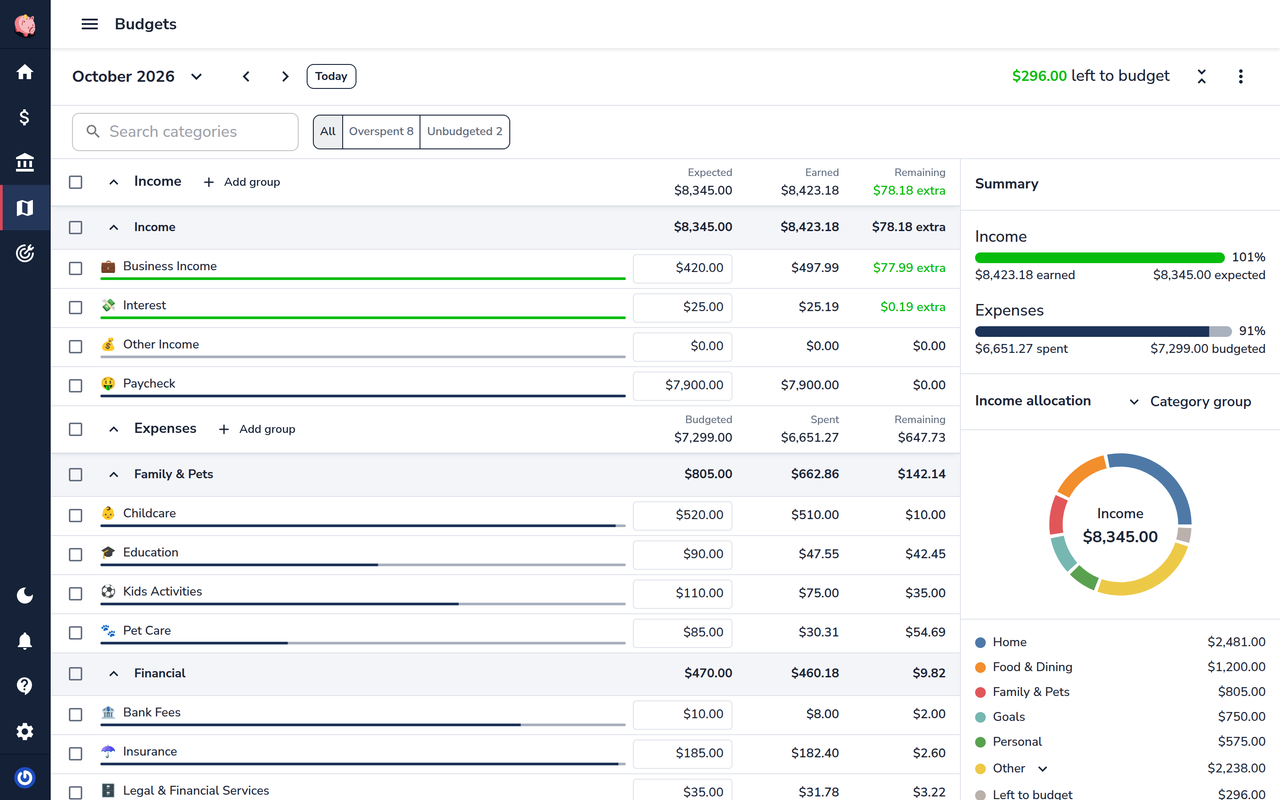
A budgeting app does this sorting for you. In Bigger Piggy, the income allocation chart on the budgets page shows how your expected income is divided across category groups, so you can see your needs-heavy groups next to the rest. The app does not label spending as needs or wants, so you map your groups to the three buckets yourself.
When 50% is not enough for needs
In many cities, rent alone takes close to half of take-home pay. If your needs run at 60% or more, forcing them into 50% leads to a budget you abandon in week two. Adjust the rule instead:
- Set needs to the percentage you actually pay.
- Protect savings first. Even 10% beats zero.
- Take the remainder from wants.
A 60/20/20 or 60/30/10 split is a perfectly good version of the same idea. The value of the rule is the three-bucket habit, not the exact numbers.
Variable income
If your pay changes from month to month, base the rule on a baseline month, not your best one. Suppose your last six months of income were $3,600, $5,200, $4,100, $4,800, $3,900 and $5,000. Using the lowest month, $3,600, gives:
| Bucket | Share | Amount |
|---|---|---|
| Needs | 50% | $1,800 |
| Wants | 30% | $1,080 |
| Savings and debt | 20% | $720 |
In months you earn more than the baseline, send the extra to savings or debt first.
Where the rule falls short
- It ignores your goals. Someone paying off a high-interest card may want savings and debt at 30% or more.
- It treats all debt the same. Minimums sit in needs and extra payments sit in savings, which can feel arbitrary.
- It is a starting point. Once you know your real split, build targets for each category, not just three buckets.
Frequently asked questions
Is the 50/30/20 rule before or after tax?
After tax. Use the amount that lands in your bank account.
Do debt payments count as needs or savings?
The minimum payment is a need. Anything you pay above the minimum counts toward the 20% bucket.
Is 50/30/20 realistic in an expensive city?
It can be, but often needs run higher than 50%. Use your real needs percentage and keep the savings share as high as you can.
What if my income changes every month?
Build the budget on a conservative baseline month and put anything above it toward savings or debt.
Try it on your own numbers
Pull up last month's transactions and work through the table above. To turn the split into category targets, see how to start budgeting. If you want a savings target to aim at, the savings goal calculator turns it into a monthly amount. If your 20% bucket is going to debt, the debt payoff calculator shows how long it takes, and debt snowball vs avalanche helps you choose which debt to pay first.
To see whether the budget is working, calculate your net worth every few months and watch the trend.
Not financial advice. The numbers above are examples.